Wednesday, October 1, 2008
Pakistan to raise Australia stand in ICC meet
Wednesday, September 24, 2008
ICC may control T20 Tournaments
"All these tournaments are springing up and what we are trying to do is regulate them in a more effective way. A private businessman might have different ambitions but we have to protect the game of cricket," ICC Chief Executive Officer Haroon Lorgat was quoted as saying.
"Twenty20 is an opportunity that people have spotted they can take advantage of, but that doesn't detract from what has been agreed by all members that we will not sacrifice nation-v-nation cricket. Everyone recognises its importance. People are not disregarding it," he said.
Interestingly, Lorgat's comment came days after 6 Bangladesh cricketers, including former captain Habibul Bashar, resigned from the national team in an apparent move to join the rebel Indian Cricket League (ICL).
"If there wasn't an interest in the sport there wouldn't be so many challenges. I would rather come into a scenario where things are moving at great speed, with new forms of cricket and a new audience," the South African added.
The Champions League Twenty20 tournament will also be held here in December, and the rebel ICL will also start its third session from October 10.
Thursday, September 18, 2008
Cricket South Africa president quits
Thursday, September 11, 2008
Dhoni and Yuvraj win ICC awards
India one-day captain Mahendra Singh Dhoni was named the International Cricket Council (ICC) 2008 one-day international player of the year here on Wednesday. At the same awards ceremony, Dhoni's India team-mate Yuvraj Singh became the inaugural winner of the Twenty20 international performance of the year. Dhoni beat fellow nominees Sachin Tendulkar, Australia quick Nathan Bracken and Pakistan batsman Mohammad Yousuf to win the award. During the voting period, Dhoni played 39 ODIs and scored 1,298 runs at an average of 49.92 and at a rate of 82.46 runs per 100 balls faced. In that time he hit a century and nine fifties. The wicket-keeper also made 62 dismissals (46 catches and 16 stumpings) in the same period. Dhoni, currently ranked as the world's best ODI batsman, said: "I am really happy to get this - it's a great privilege. "Also, it feels great to know that I am the first Indian player to get this particular award and it's very special because now I am in the company of a lot of other good cricketers. "Some fantastic players have won this award in the past and to be mentioned in their company is truly a humbling experience for me." Yuvraj's award was recognition for the batsman's feat in hitting six sixes off an over from England fast bowler Stuart Broad during the ICC World Twenty20 in South Africa last year, which India eventually won after defeating Pakistan in a thrilling final. It was the first time a player had hit six sixes in a single Twenty20 international over. Herschelle Gibbs did it in an ODI during the last year's World Cup in the Caribbean while West Indies great Garfield Sobers became the first man to achieve the feat in a first-class match back in 1968. "I would like to thank the ICC for recognising the performances of the players - it's an important aspect of the year for us," said Yuvraj. "After the fifth six in that over I remember having butterflies in my stomach and I knew that if I managed to hit it for six it would be very special. It was a great feeling when I saw the ball go over the boundary."Friday, July 4, 2008
Zimbabwe pull out of World Twenty20
"We have decided to pull out in the larger interests of the game," Peter Chingoka, the chairman of Zimbabwe Cricket, told Cricinfo. "We have been informed that the British government may not grant visas to our players, and that situation may prevail during the Twenty20 World Cup. We don't want to be gatecrashers."
"It was a collective decision and I was a part of that decision," Sharad Pawar, the BCCI president, told Cricinfo.
"The full membership of Zimbabwe is currently not in doubt," ICC president David Morgan said. "There was not even a discussion on the issue of Zimbabwe's membership."
The decision, Chingoka said, pertained only to the tournament in England. "We are now looking forward to more tours and international cricket with our Asian friends, especially India."
The Zimbabwe issue had occupied a large part of the discussions during the ICC executive board meeting, which carried over to an unscheduled third day on Friday after a failure to reach a consensus.
Some countries, led by England and South Africa, had been pushing for Zimbabwe to be stripped of Full Member status but that move had been opposed by India.
Ray Mali, the former ICC president, has recommended the setting up of a sub-committee to "advise the ICC board on all matters relating to Zimbabwe cricket including its return to full participation in the international game. The specific terms of reference for the sub-committee will be finalised in due course." The sub-committee, if approved, will chaired by Julian Hunte, the head of the West Indies board, and include Arjuna Ranatunga and another official (who hasn't been confirmed).
Source: www.circinfo.com
Monday, June 30, 2008
Chingoka slams ICC decision as unethical

June 30, 2008, Peter Chingoka, the chairman of Zimbabwe Cricket, has criticised Ray Mali, the ICC's outgoing president, for tabling a motion to discuss the future of Zimbabwe when the ICC meets in Dubai this week.
In two letters which followed Mali's announcement, Chingoka forcibly reminded him that the ICC had already discussed the matter. "You will recall that last year in London, a decision was taken and well-supported by you and other members that sport and politics, like oil and water, do not mix."
Quoting the ICC's own rules, Chingoka insisted that Zimbabwe's status could only be discussed at next year's annual conference as such a motion needed to be tabled by December 31 in the preceding year. Ironically, a change to the rules was proposed two years ago to allow more immediate action to be taken. Chingoka opposed that at the time and the move was defeated after India indicated they would not support it.
The letters also highlighted a breakdown in relations between Chingoka and Mali, hitherto seen as close allies. Less than a year ago, Mali was effusive in his praise for the ZC administration following a six-day fact-finding visit. But last week he told Chingoka that he had acted because he "owed it to the cricket community to feel all is normal
Chingoka, playing the race card, warned Mali of "setting double standards and discriminatory levels that go against the ICC anti-racism code".
He went on to accuse Mali of making Zimbabwe "a scapegoat" for the decision to stand down Malcolm Speed as the ICC's chief executive in April and called the latest announcement of the discussion on Zimbabwe "unethical", adding it was an "agenda item infested with political connotations". He concluded by asking: "Whose political gallery these antics are being supposed to appease?"
"There are over 100 ICC member countries with differing political environments," he continued. "Without venturing to mention names as it is apparent, it is clear that certain worse conditions exist in those other member countries. It has not warranted the ICC putting them on its agenda as it is doing with Zimbabwe right now."
Source: www. cricinfo.com
Tuesday, June 17, 2008
The ICC's umpire review system, 'On-field umpires should be respected' - Jayawardene
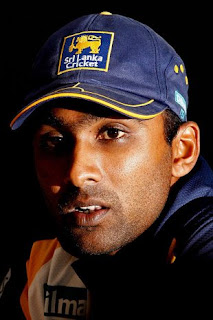
Mahela Jayawardene, the Sri Lanka captain, feels that the new umpire decision review system that will be implemented on a trial basis during the home Test series against India next month should be utilized in a manner that shows respect to the on-field umpires.

Jayawardene said he welcomed the trial but admitted that it would place more responsibility on the captains.
"In general, the system will be good for the game as it will reduce the scope for mistakes," Jayawardene told Cricinfo. "But you need to do it in a respectful way. The on-field umpires are human, after all. They do make mistakes, just as everybody else does, and we should respect that during the trial. We should be clear that the idea is only to reduce the mistakes."
Jayawardene revealed that his team would be holding extensive discussions prior to the series on how to utilise the system in the "best manner possible". "We will take the views of everybody on what is best for the team. We want to keep it simple and not make it into a complicated issue."
He dismissed suggestions that the system would mean extra pressure on the captain, but admitted that it will bring in added responsibility. "It seems so. Especially because you have three chances and the captain takes the call for the fielding side. But while batting, others share the responsibility - it's the batsman who has to take the call and maybe, he can consult his partner before doing so."
David Richardson, the ICC's acting chief executive, said that the decision to trial the system during India's visit to Sri Lanka is "an attempt by the ICC to enhance still further the game at the international level".
"The system will see the fielding and batting side allowed three unsuccessful appeals to the umpire per innings to change a decision if it is perceived to have been incorrect," the ICC said in a press release. "These appeals can be made only by the batsman in receipt of the umpire's original decision or the captain of the fielding side, in both cases by the player making a 'T' sign with both forearms at shoulder height.
"The on-field umpire will consult with the third umpire, who will review available television coverage of the incident before relaying fact-based information back to his colleague. The on-field umpire will then deliver his decision either by raising his finger to indicate "out" or by crossing his hands in a horizontal position side to side in front and above his waist three times - as per a "safe" decision by an official in baseball."
The BCCI said on Monday that it has agreed to implement the trial for the three-Test series from July 23 to August 12.
source: www.Cricinfo.com
Thursday, May 22, 2008
Shah Rukh would not attend IPL matches
By Khabrein.info Correspondent,Mumbai, May 23: Shah Rukh Khan has said that he would not attend the remaining matches of the IPL due to the bar set on him by ICC. The actor owns the Indian Premier League’s (IPL) Kolkata team. He was stopped from entering his team’s dressing room by ICC officials.
A dejected Shah Rukh who has paid more than 300 crore rupees for his team said, “The Indian Premier League (IPL) has its set of rules and regulations and I am a law-abiding person. But why pick on me? Other team owners are seen near their players. Is it because I am a celebrity and vulnerable?”.
His team that has failed to qualify for the semi finals despite having star players and initially being seen as the top contender for the tournament is also marred by rumours of rift between captain and owner of the team.
But Shah Rukh Khan seems to be more concerned over the behaviour of ICC and BCCI officials. “I have paid my players to win. Will I pay them now to lose? This is illogical”, said Shah Rukh Khan.
Shah Rukh Khan was banned from visiting the players’ dressing room and dug out. The BCCI had asked the actor not to violate ICC code of conduct.
The move comes after the ICC asked the BCCI to question Shah Rukh Khan for his on field conduct.
Shah Rukh Khan has been putting in extra efforts to prop up his team and also encourage the players. It has been observed that his team Kolkata Knight Riders lost all the matches when the actor was not present during the match.
SRK while commenting on the BCCI move said, “I like to hang around with the boys. I am very energetic. I am very disappointed that the ICC has stopped me. I don’t know the rules. I’ll tell only one thing. Nobody dare stop me from coming to Calcutta. I’ll be here whenever my team plays a match at the Eden”.
The Bollywood star says that he was not happy with the performance of his team. “But this is a game and if there is a winner then there has to be a loser too,” SRK said.
Cricket
Cricket is a bat-and-ball sport contested by two teams, usually of eleven players each. A cricket match is played on a grass field, roughly oval in shape, in the centre of which is a flat strip of ground 22 yards (20.12 m) long, called a cricket pitch. A wicket, usually made of wood, is placed at each end of the pitch.
The bowler, a player from the fielding team, bowls a hard, fist-sized cricket ball from the vicinity of one wicket towards the other. The ball usually bounces once before reaching the batsman, a player from the opposing team. In defence of the wicket, the batsman plays the ball with a wooden cricket bat. Meanwhile, the other members of the bowler's team stand in various positions around the field as fielders, players who retrieve the ball in an effort to stop the batsman scoring runs, and if possible to get him or her out. The batsman — if he or she does not get out — may run between the wickets, exchanging ends with a second batsman (the "non-striker"), who has been waiting near the bowler's wicket. Each completed exchange of ends scores one run. Runs are also scored if the batsman hits the ball to the boundary of the playing area. The match is won by the team that scores more runs.
Cricket has been an established team sport for hundreds of years and is thought to be the second most popular sport in the world, after football (soccer). More than 100 countries are affiliated to the International Cricket Council, cricket's international governing body. The sport's modern form originated in England, and is most popular in the present and former members of the Commonwealth. In many countries including Bangladesh, India, Pakistan, Sri Lanka and the English-speaking countries of the Caribbean, which are collectively known in cricketing parlance as the West Indies, cricket is the most popular sport. In Australia, while other sports are more popular in particular areas, cricket has been described as the "national sport" and has had a role in forming the national identity.[3] It is also a major sport in England, New Zealand, South Africa and Zimbabwe . Many countries also have well-established amateur club competitions, including the Netherlands, Kenya, Nepal and Argentina.
The sport is followed with passion in many different parts of the world. It has even occasionally given rise to diplomatic outrage, notoriously the Basil D'Oliveira affair (which led to the banning of South Africa from sporting events) and the Bodyline Test series in the early 1930s (which led to a temporary deterioration in relations between Australia and the United Kingdom).
From Wikipedia, the free encyclopedia Source: wikipedia.org